
Invisible assumptions
A critical reading of Fourie-Siebrits (2026)

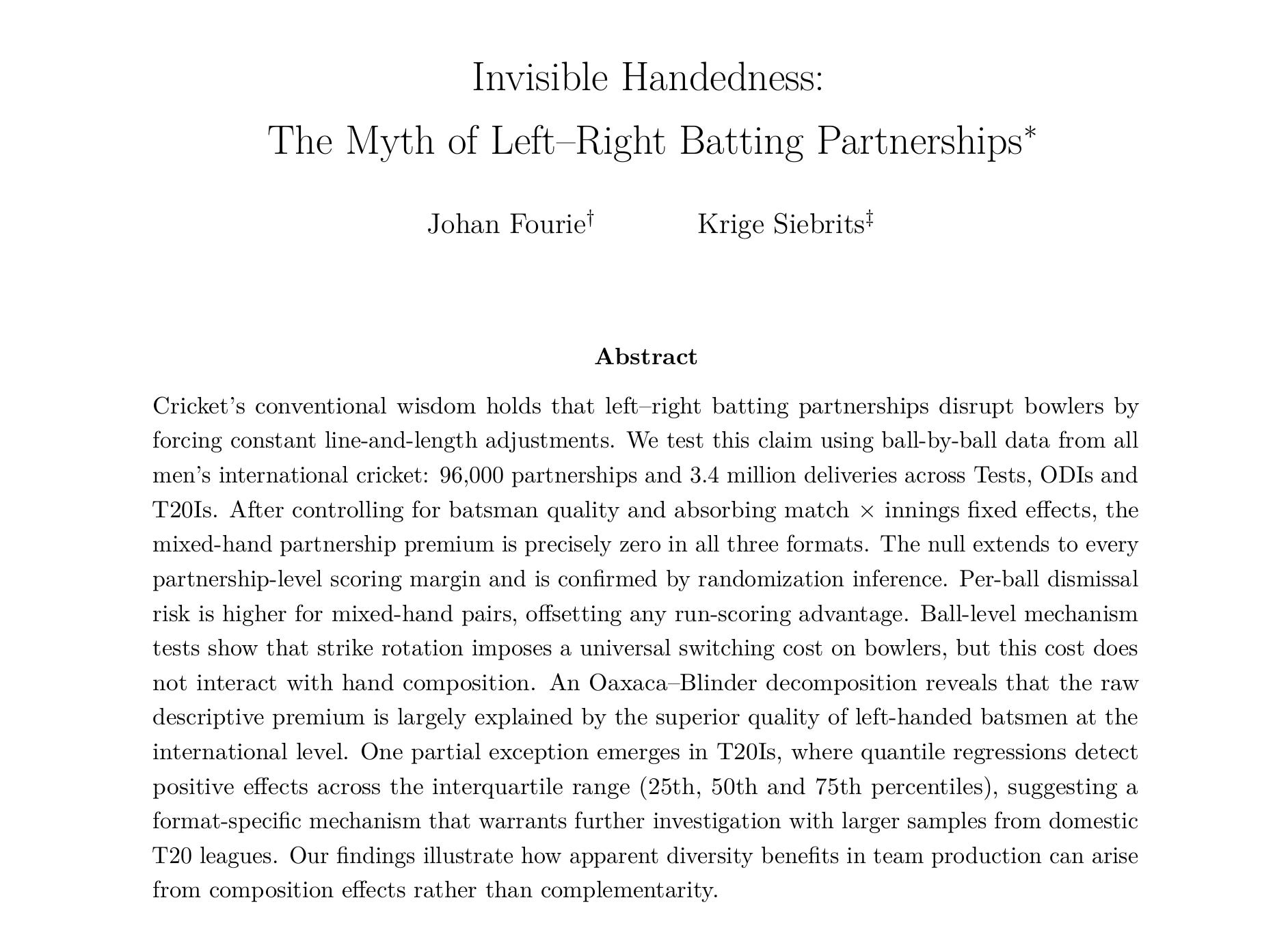
It appeared the dust had settled on the recent academic article by economists Johan Fourie and Krige Siebrits, in which the authors used ball-by-ball cricket data to argue that mixed-hand partnerships wield no noticeable effect on batting output, at least in the longer formats of the game. However, five days ago, the paper was featured on the African editorial platform operated by Nature, which celebrated the perspicacity of two academics who had punched a hole in one of the sport’s oldest myths.
Cricket & Stuff is not a blog which aims to throw shade on the work of others. But I am a cricket data person, and I am also an economics student. Seeing as the Venn Diagram of these two sets is basically a dot, I guess this makes me something of an authority on this quaint subject. A criticism of this paper has already been posted by the persuasive CricChimp, in which he points out that the paper commits a conceptual error by equating pre-match batting average with whatever we call the “quality” of a player. What I want to do is different. In this article, I investigate the econometric framework underlying the Fourie-Siebrits paper. I will argue that the paper is best seen by cricket analysts as a push towards causal inference, without providing the definitive answer to its research question.
At the outset, I must put forth an answer to a question that will doubtlessly confound many. Why is an economist’s point of view even valuable to cricket analytics to begin with?
The claim to fame of economics in the last fifty years lies in what is called the credibility revolution. Since economists lack the luxuries of a lab, where a clean control and treatment group can be experimentally obtained, they are in constant tussle with messy secondary data. Secondary data is rife with problems of endogeneity, where variables internal to the model are explained by other variables. Every time a feature, say Parental Income, changes, so does another feature, say Education. Every time Education changes, so does something unobservable like Skill. If I were to study the effect of parental income on an individual’s earnings, there is no simple way of knowing if I am truly picking up the effect of Education or Skill. In other words, a descriptive approach only maps the correlational effect of Parental Income on Earnings, whereas we are usually interested in causality: can we say that changing x while keeping everything else constant leads to a change in y?
Economists were amongst the first to develop methods that could resolve such problems, using clever research designs such as, for instance, the viciously named Regression Discontinuity Design. The RDD exploits the inherent exogeneity of arbitrary cut-offs: There is nothing systematically different between a student with a 3.59 GPA and one with a 3.61 GPA, except that the latter secured Latin honours. So if I want to study the effect of educational achievement on earnings, I can simply compare two cohorts of students immediately on either side of the cut-off, under the plausible assumption that any difference in future earnings must be caused by the only systematic difference between the two, the Latin honours. Similarly, elections in many states are scheduled by neutral governing bodies devoid of strategic considerations, thus it is plausible that the electoral period is exogenous and any change in observed political behaviour around this time must be caused by proximity to the election.
So you will find economists in fields as diverse as criminal law and evolutionary biology because they are trained to use limited data to make the leap from correlation to causation. And cricket is the holy grail of limited data. If you consider the complete record in cricket as being the sum total of the biomechanical actions of the players, and the pre-release, pre-interception and post-interception trajectories of the ball, then we are still less than halfway towards documenting our sport’s record. Moreover, given that it is expensive and perhaps even ethically sketchy to pin retroreflective markers on live athletes to collect accurate biomechanical data, simulating experimentally clean conditions may well be a wild goose chase. The techniques of causal inference provide a framework for overcoming the absence of clean experimental conditions by doing away with stubborn endogeneity problems.
What, then, is the endogeneity trap which plagues the question considered by Fourie and Siebrits? A simple comparison of mixed-hand and same-hand batting pairs is causally meaningless because mixed-hand and same-hand pairs are fundamentally different groups. Since most batters are right-handed, most same-hand pairs contain two right-handers. Mixed-hand pairs, on the other hand, contain one left-hander by definition. So the observed superiority of mixed-hand pairs could just be a reflection of the well-known advantage enjoyed by left-handed batters, rather than an artefact of the diversity of handedness at the crease.
This is not the only concern. Though Fourie-Siebrits do not explicitly reference this, another fact we know from the cricketing discussion surrounding handedness is that countries where fast bowlers enjoy the advantage over spinners lead to the proliferation of left-handers at the top level, because from right-arm-over, the sport’s most common angle, southpaws get to avoid the risk of lbw. (More on this later.) Thus, most mixed-hand batting partnerships are simply Australian and South African pairs. These countries have typically produced high-quality batters, so the superiority of mixed-hand batting pairs observed in the full record could just be the high skill levels of players from these countries. In a nutshell: handedness is not exogenous, so there is no guarantee that the observed benefit of one kind of handedness is owed to the handedness itself, rather than other co-varying traits.
How do Fourie and Siebrits attempt to overcome this? First, they aim to control for the “skill level” of a batter. The hope is to ask: if mixed-hand and same-hand pairs had the same skill, would the former average more than the latter? But skill is fundamentally unobservable. There is no way of observing and documenting skill when we can’t even agree on a definition. The compromise made by Fourie and Siebrits in this case is to use a batter’s pre-match batting average as a proxy for skill. This is the approach used in what they label their “preferred specification”.
There are two problems here. First of all, proxies are prone to errors. While it is true that measurement errors, as long as they are uniformly or randomly distributed, do not distort inference, a proxy which generates non-random errors is unsuitable for causal analysis. Since a random or uniform error is uncorrelated with the true variable, it simply dilutes the signal rather than introduce a spurious correlation. However, the same can’t be said for errors which are explained by variables internal to the model (for the full intuition, see here). Now, think about the batting average for a second. Does it randomly or systematically underestimate the quality of players with tough home conditions? Does it randomly or systematically discriminate against old batters? Does it randomly or systematically inflate the averages of batters who stay not-out at the end of an innings? A proxy which produces errors that are predictable by variables internal to the model is meaningless.
This relates to the second problem with using a systematically error-prone proxy. So far we only had to worry about one variable in the regression equation—the prevalence of mixed-hand batting pairs—being endogenous to the model. Now we have to worry about one more! The fact that a player’s pre-match average is itself determined by other unobservables, including their history and skill, renders the estimated effect non-causal. If the solution to a problem creates a new problem, then is it really a solution at all?
Thankfully, Fourie and Siebrits use another standard tool from the economics literature to mount their case against mixed-hand batting pairs: the instrumental variable. Now hold on to your hats, because things are about to get really technical.
An instrumental variable is a source of exogenous variation which influences one’s output variable y only through one’s input variable x. Consider, for example, the regression equation y = αx + β. The coefficient α may not reflect the causal effect of x on y for various reasons. One solution to this problem lies in finding a variable z, which is (1) highly correlated with x, and (2) is not correlated with anything else which has a shot at causing y. We call z an instrumental variable, or an instrument. If we have such a z, we can use z to get a prediction of x. Since z is uncorrelated with all other causal mechanisms, this prediction would be independent of them too. Now we can estimate the effect of the predicted values of x on y to estimate the causal effect α. Under the assumptions that z is heavily correlated with x, and z is uncorrelated with other factors, it can be mathematically shown that the estimated effect α is the true causal effect of x on y.
An example is helpful here. A contentious topic in contemporary politics is whether colonialism is to blame for the poverty of several Asian and African countries. However, colonized regions are hardly the same as those which resisted colonization—for example, maybe the former succumbed to colonialism because they were poorly governed, so their persistent poverty is the result of a history of poor local governance rather than British brutalities. The economist Lakshmi Iyer noticed that the Doctrine of Lapse, a short-lived annexation policy of the British whereby princely states with no recognized heir went to the British after the death of the ruler, could be used as an instrument for colonialism. Since deaths are largely exogenous events, it is plausible that the only way in which the Doctrine of Lapse can affect contemporary economic wellbeing is through being colonially occupied itself. This allows Iyer to demonstrate that a history of British rule has caused lower levels of public goods in the present period.
Now before you forget that this is a cricket blog—Fourie and Siebrits do attempt to assuage remaining endogeneity concerns using an instrumental-variables strategy. To do so, they compute the probability that a partnership is mixed-hand, given that there is a known number of left-handers and right-handers in a squad. So in effect, they instrument for the prevalence of mixed-hand pairs using the probability that any pair is mixed-hand.
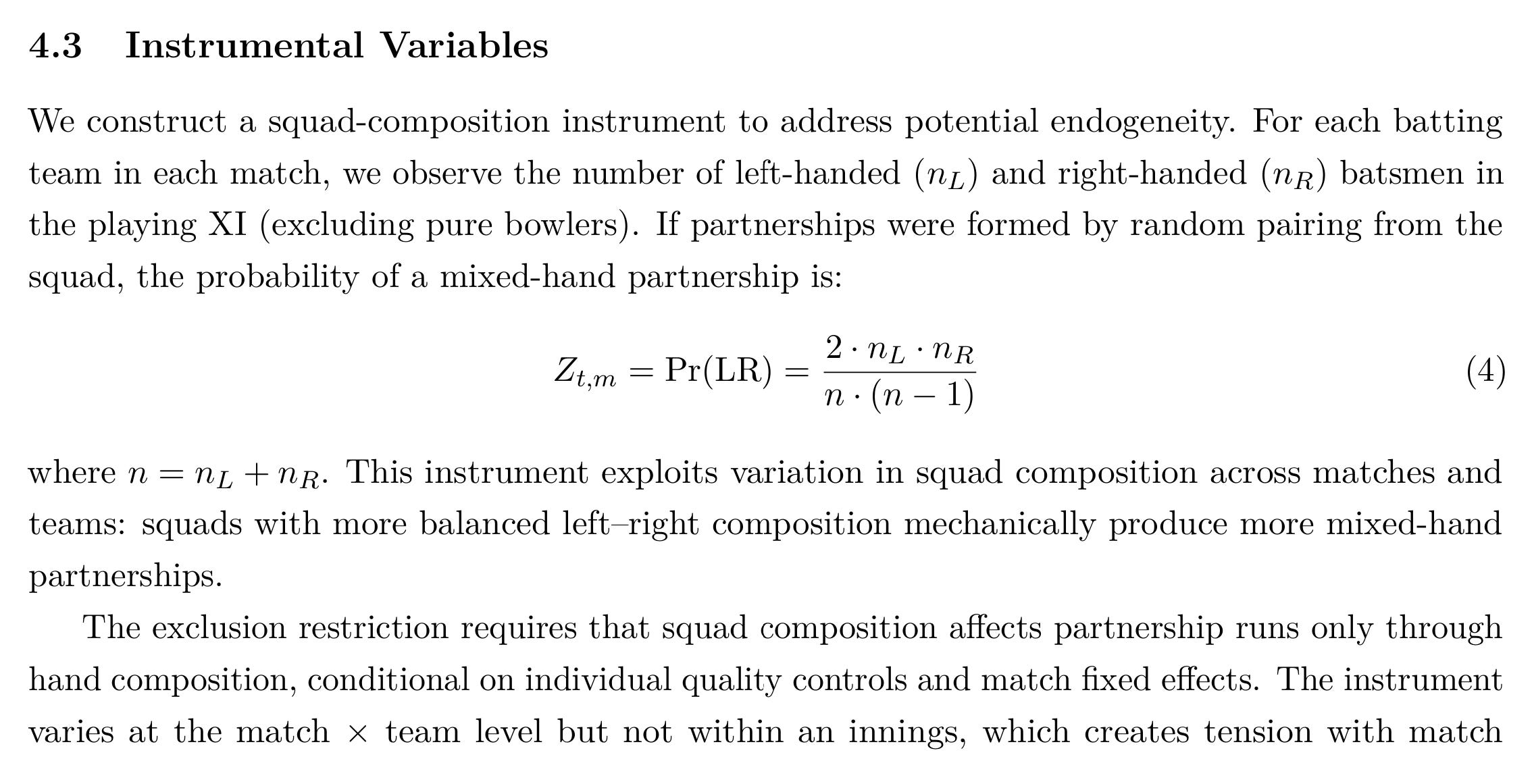
It is easy to see that this instrument must satisfy the first condition for a good instrument: obviously the probability that a pair is mixed-hand is closely tied to its observed handedness. But hold on—how on earth can this variable satisfy the second criterion? The so-called exclusion restriction requires that the instrument be uncorrelated with other factors likely present in the regression equation, including but not limited to: the spin-friendliness of the native countries of the batters, the incidence of round-the-wicket bowling in the domestic competitions, and umpiring standards at lower levels. Why these specific features? We know that three of them could be linked with the availability of top-level lefties in a team, and all three are unobservable. The more spin-friendly a nation, the more young lefties who get bested by offspinners; the more seamers go round the wicket, the more the left-hander’s pads get attacked; the more local umpires raise their fingers, the more the right-arm-over angle penalizes the southpaw. There is no way to control for any of these possibilities since we lack the data, and without controlling for them (and possibly several other co-variates), our instrument does not satisfy the second condition.
The point is this: the percentage of left-handed talent which makes it to the international level does not provide an exogenous source of variation. It is determined endogenously by several other variables which play a role in the calculus of cricket, so it is dubious to use it as an instrument.
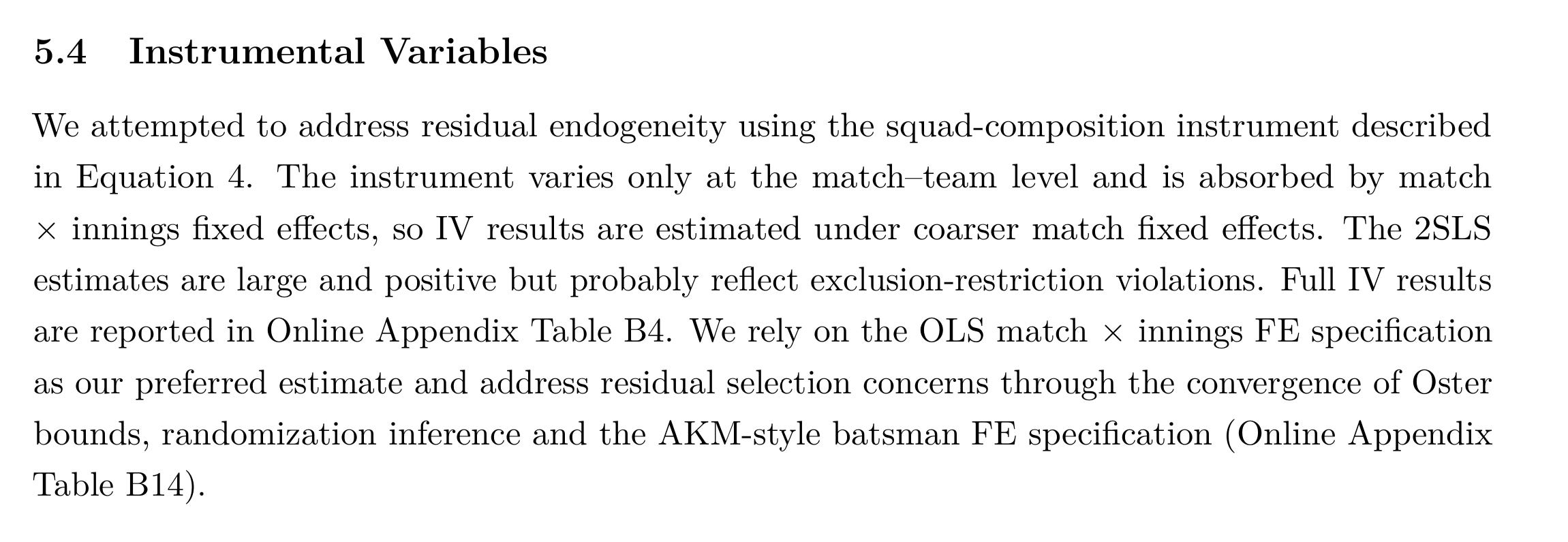
The fact that their instrument is likely not exogenous is acknowledged by the authors themselves when they proceed to estimate the effect via the instrumental-variables strategy and receive a positive coefficient which signals that mixed-handedness does, indeed, have an effect on batting output. The paper also deploys several more esoteric statistical devices to argue further in favour of its main conclusion, but as far as I can tell, these devices are neither standard in econometric theory, nor do they tackle the question of causality.
So what is the upshot? Is Fourie and Siebrits’ a bad study? This is the conclusion arrived at by ChimpThought, but my own thoughts are more measured. I think this paper is an excellent contribution to cricket analytics. Prior to this study, there wasn’t a single public-facing analysis of the handedness problem that had acknowledged the possibility that the reason why mixed-hand pairs seem to average more than same-hand pairs could simply be that mixed-hand pairs are likelier to contain a left-hander. This is a question that has been beleaguered by confounding factors no one in the cricket analytics community took note of for years. For being the first cricket data work which attempts to go past the realms of correlation to causation, Fourie-Siebrits deserves credit.
However, is it a good economics paper? Would it get published in a top economics journal? As far as its current version is concerned, the answer is no. Though it introduces an interesting new framework, the methodological guardrails of the paper are not strong enough or novel enough to be considered as having expanded the economist’s pool of knowledge. The question of handedness continues to evade a conclusive answer, and the impetus is on future cricket analysis to resolve the paradox. The analysis which does so will need to cite Fourie-Siebrits as the first to point out the endogeneity concerns which muddy the waters.